
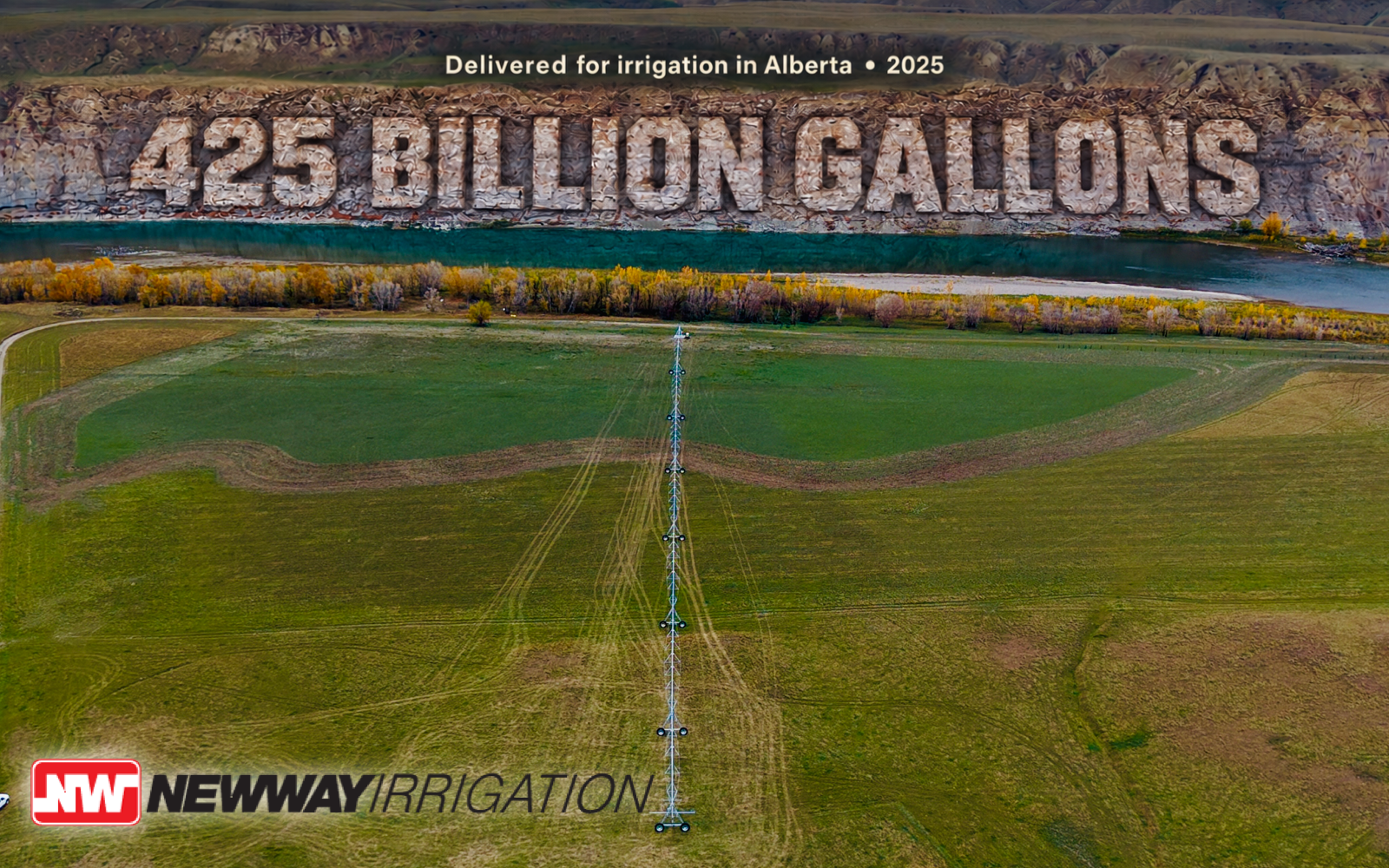

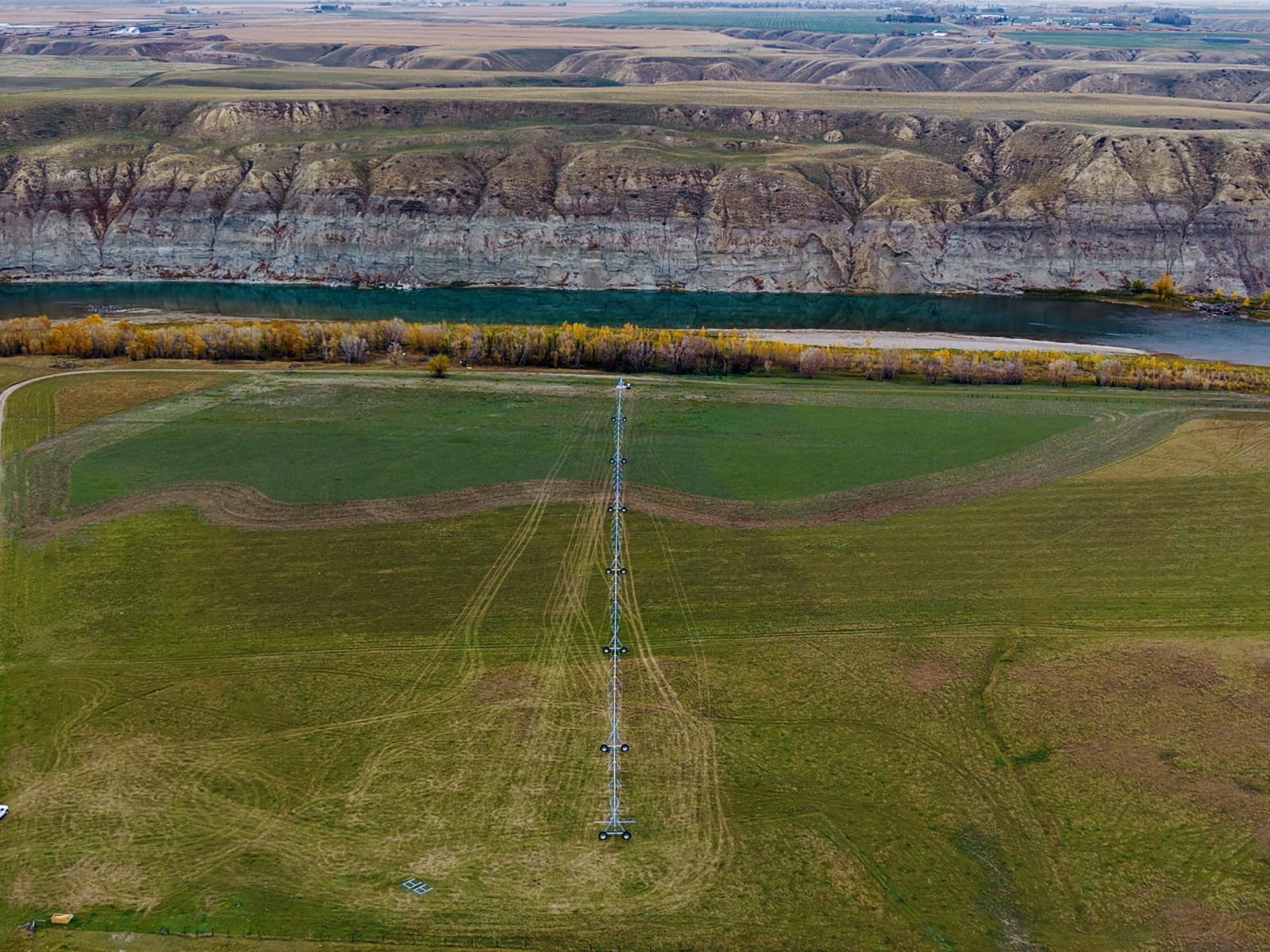
A Zimmatic pivot beside the Oldman River. Provincial water figures describe the wider irrigation-district system, not this individual field.
From above the Oldman River, you can see the connection: water, farmland and a pivot stretching across the field. But this view is one part of a much larger story.
Alberta’s irrigation districts draw water from several river systems. The province’s 2025 report lists sources including the Bow, Oldman, Belly, Waterton and St. Mary rivers, along with Gros Ventre Creek for Ross Creek Irrigation District. Reservoirs, canals and pipelines help store and move that water through the district systems.[1]
In 2025, the province’s estimated district water balance put the amount delivered for irrigation at approximately 1.61 trillion litres — about 425 billion U.S. gallons.[1]
Watch Alberta’s water story
View this post on Instagram
What does ‘diverted’ actually mean?
The larger diversion total tells a different part of the story. Alberta’s irrigation districts reported gross diversions of approximately 2.21 trillion litres, or 583 billion U.S. gallons. That’s equivalent to about 883,000 Olympic-size pools, using a comparison pool measuring 50 metres long, 25 metres wide and two metres deep.[1]
That’s a lot of swimming. Not one lifeguard.
But diverted isn’t delivered. Gross diversion measures water diverted from reservoirs or river systems by irrigation districts. It is different from water supplied for irrigation, and different again from water consumed by crops.
District systems also supply other users, manage reservoir storage, return water to rivers, and account for seepage and evaporation. Other uses include municipal, domestic, agricultural, industrial and environmental purposes.[1]
The 2025 estimated water balance covers Bow and Oldman basin districts; the gross-diversion table also includes Ross Creek Irrigation District. Some water-balance components are estimates, including seepage and evaporation figures carried forward from 2023. These figures should not be treated as a precise measurement of crop consumption or system efficiency.[1]
The photographs beside the Oldman River bring that story into view. The numbers describe the wider district system, not the water used by this particular field or pivot. They also do not cover every independently licensed irrigation withdrawal across Alberta.

Water, farmland and irrigation infrastructure in the Oldman River valley.
The contribution reaches beyond the farm gate
Irrigation also connects farms with processors, suppliers, trades and other businesses.
A 2021 study commissioned by the Alberta Irrigation Districts Association estimated that irrigation-district-related activities contributed an average of approximately $5.4 billion annually to Alberta’s GDP and supported about 46,000 full-time equivalent jobs during 2011–2018.[2]
Those are historical economic estimates, not current-year totals. They include direct activity and wider effects through suppliers, processing and household spending. GDP measures value added to the economy; it is not farm sales or profit.
The land footprint makes that contribution even more striking. Over the study’s 2011–2018 period, irrigated land within the districts represented just 4.4% of Alberta’s cultivated land base. Yet the associated crop, livestock and food-processing activities contributed about 28% of the province’s agri-food GDP.[2]
That helps explain why irrigation matters beyond the acres under a pivot. It connects crop production with livestock feeding, processing plants, suppliers and skilled trades.
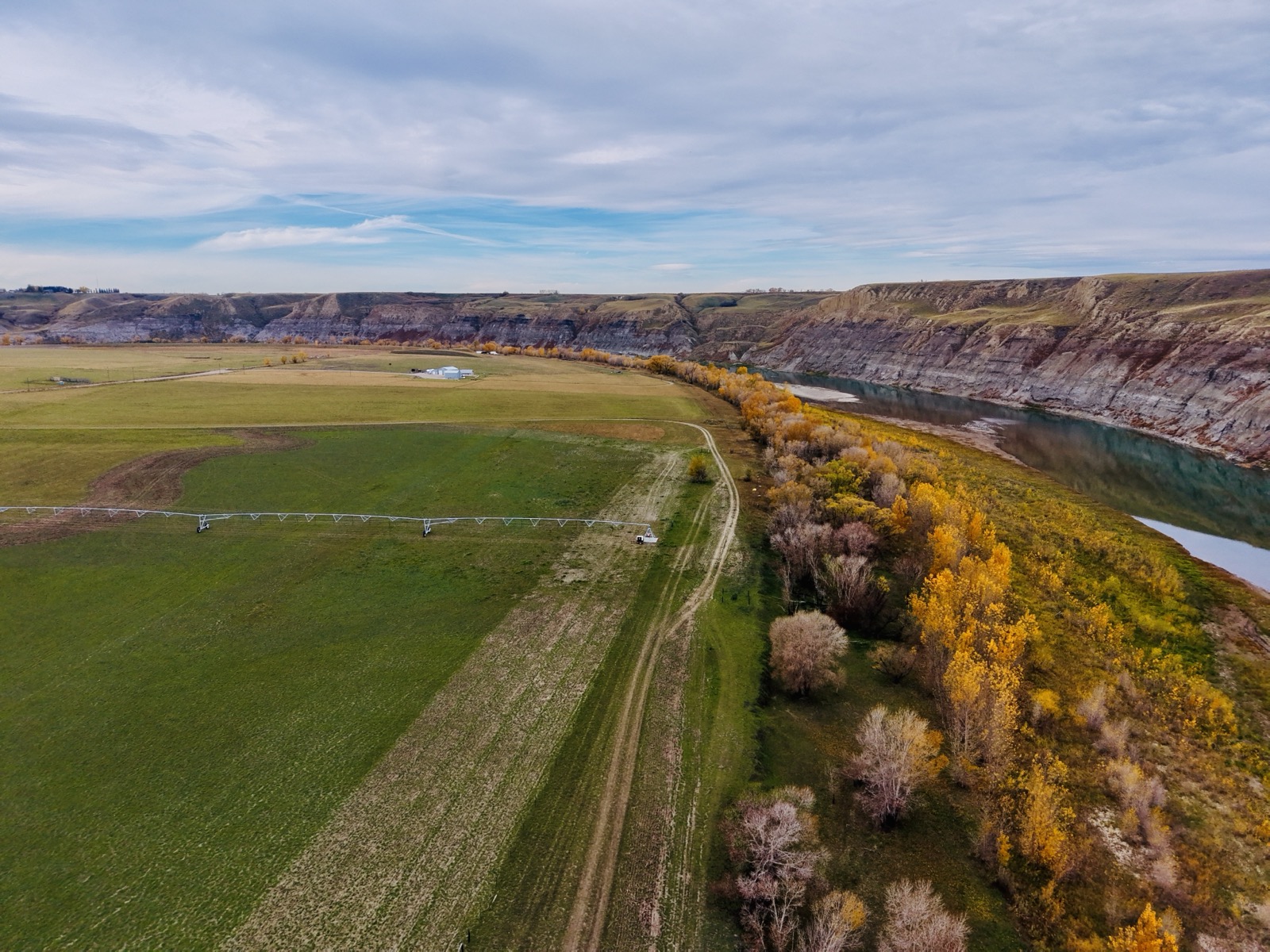
Irrigation equipment and autumn along the Oldman River.
Where New Way fits
Provincial figures describe the work of many growers, districts and businesses. New Way Irrigation’s part is practical: supplying Zimmatic equipment and supporting growers with irrigation parts, repairs, maintenance, pump work, electrical service and installation.[3]
Technology can be part of that support. FieldNET offers remote monitoring and, with the appropriate installed equipment, control capabilities. Features depend on the system, hardware, connectivity and service in place; the photos alone do not tell us which capabilities this pivot has.[4]
For growers, the useful conversation starts with the actual operation: the equipment already in the field, the work it needs and the people available to support it.
New Way Irrigation serves growers across Alberta, with locations in Lethbridge, Taber and Brooks.
Talk with New Way about your irrigation system or next pivot project.
Sources and data notes
Water data: 2025. Economic study period: 2011–2018. U.S. gallons are used throughout.
- Government of Alberta, Alberta Irrigation Information 2025, published June 25, 2026. Table 9, p.26, district water sources; Table 10, p.27, gross diversions; Figure 7, p.28, diversion scope; Table 11, p.29, estimated water balance. Conversions are approximate; pool dimensions are illustrative.
- AIDA, Economic Value of Alberta’s Irrigation Districts (2021), executive summary and Table E.1, p.7. Annual averages and land/economic comparisons for 2011–2018.
- New Way Irrigation services, checked October 19, 2026.
- Lindsay FieldNET capability documentation. Features depend on selected equipment.

